
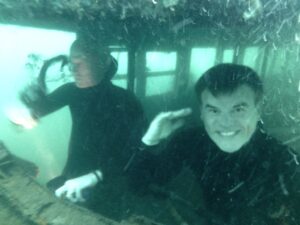
Great video to start off the New Year

2 01 2012

This is a beautiful video showcasing freediving.


More information about the people who made the video can be found here: http://www.weightlessemotions.com


Freedive Toronto on Citytv’s Breakfast Television

11 08 2011

Toronto, Friday August 5, 2011
It was an early rise for the Freediving National Championships organizers, crew and athlete this morning as they appeared in today’s Breakfast Television show with Sangita Patell and the LiveEye crew at the Etobicoke Olympium Pool. Under the watchful eye of Freedive Toronto President and AIDA Instructor Doug Sitter, Sangita faced her long-standing fear of water and attempted a breath-hold performance called static apnea, which is a discipline of freediving done on one breath of air, face down in the water without the exertion of movement. This discipline is measure of time spent on a breath-hold (also called sportive apnea). For a first timer, Sangita did really well in her attempt, reaching a personal best of 56 seconds.


Montreal Pool Competition – Dynamic No Fins

16 04 2011

Preliminary results from the DNF. Looking forward to tomorrow.

20110416-063001.jpg


Montreal Pool Competition 2011 – Static Results

16 04 2011

These are the preliminary results of the Static event.

20110416-024123.jpg


Making a Freediving Neck Weight

6 03 2011

We often get asked about neck weights and I recently needed a heavier neck weight so I decided to create this post to show how to make one.

Below are two images showing the supplies needed.

01 Neck Weights - Supplies

02 Neck Weight - Lead Pellets

The bag of lead pellets can be purchased at Bass Pro Shop or most other hunting stores. I bought a 25 lbs bag of very small pellets, but you might be able to find a store that carry smaller bags or maybe a dive shop that carry lead pellets. Bass Pro Shop also has the 1 inch buckles I used for my neck weight. I find 1 inch big enough to open even with cloves on and it isn’t as bulky as some of the larger buckles.

The scale, funnel and inner tube was purchased from Canadian Tire and the tape is from Home Depot. Only one color tape is needed, but I just wanted to show all the cool colors available.

03 Neck Weight - Hose and - buckles

The length of the bike tube should be the length of your neck circumference plus 20 cm. My neck is 40 cm and I cut off 60 cm of tube, which worked out nicely.

The thickness doesn’t matter as much, because the tube will expand, but I did made sure I didn’t buy a racing tire, which is very thin. The inner tube I bought can be used for a range of tire widths, ranging from 1.75″ to 2.125″.

04 Neck Weight - Buckles

There are a few ways of attaching the buckles and I have chosen the simplest solution. I find it has worked well on my last neck weight which has held up great for two years and show no signs of wear and tear. It can be a little difficult to get the tube through the ends of the buckle, but it only took me 5 minutes for the first and 2 minutes for the second buckle. Make sure to do the hardest of the buckles (if they are different) first, because the tube is easier to hold when it is empty.

There is a different way of attaching the buckle shown here from another blog: orangellous.

There are also great tips and discussions about neck weights at the Aida Canada Forums

05 Neck Weight - Weighing

The lead pellets are extremely small and hard to control, so make sure to do all the weighing and filling in a big plastic container. You should get some help from an instructor or experienced freediver with determining how much weight you need both with and without a wetsuit.

06 Neck Weight - Filling

Filling the neck weight would have been hard without a funnel and I also found out that I needed a plunger. I am creating a 5 pound neck weight and all the pellets don’t fit in the tube without stamping them and expanding the tube a bit. I filled up about 10 cm of the bike tube and then used the stick to stamp the pellets. After stamping, the tube will mostly keep the thicker shape and more pellets can be added. I did this in 5 cm increments stamping each time and made sure I had about 15 cm of tube left after adding all the pellets.

The plastic clip was very useful when adding the second buckle. I placed the plastic clip tight to the pellets which allowed me to fairly easily add the second buckle and try on the neck weight for size. The size of the neck weight stretched out was about 47 cm, but bent it was only 43 cm and with tape it finally ended up a little over 42 cm inside.

 The spoon in the picture was used to scoop up a few of the small guys that got away from me.

07 Neck Weight - Before Tape

Above is the neck weight before I taped it and before I shaped it. Make sure to spend lots of time shaping it so it will be symmetrical and  isn’t too thick in the sides. If you make it too thick in the sides it can be harder to get your arms correctly above your head for streamlining.

08 Neck Weight - Finished

This is the final look of the neck weight with two layers of tape. I added two layers to make it as strong as possible and make sure none of the little pellets have a chance to get out and so water can’t get in.

This is almost identical to my previous neck weight which has been great so far. I will be using it for our freedive practices when I don’t wear a wetsuit.  I will be creating a heavier neck weight for when I wear a wetsuit.

I hope this will help you make your own, but I will also be posting these neck weights for sale, because several people have said that they prefer to buy them instead of making them.


Family Vacation and training Benefits

11 02 2011

Just came back from Long Island Bahamas… It’s been the second formal

training for me in the span of 3 months. The first one – last October in

Monrtreal with William Winram, member of the FreediveToronto club and World Cup

Champion – I wasn’t able to attend to the full extent (damn, I have to,

given the chance again!). This second training was actually during vacation

with my wife, which, quite conveniently, “coincided” with a depth training

course by another William – Trubridge, current World Record holder on CNF

and his wife Brittany, who is a Yoga instructor with an emphasis on

breathing techniques and lung exercising. Daily yoga practices (with one really

cool session which started at sunrise right on the cliff facing the Atlantic ocean),

diving off the platform on the Dean’s Blue Hole, the supernatural beauty of Long

Island, my October training in Montreal – all of these contributed to greatly

improve my depth range and confidence. The outcome? For the first time in my life,

I crossed the 40m depth mark and 30+ meter dives became much more

comfortable than ever before. There was also the pleasant surprise of meeting Carla

Sue-Hanson – she was assisting in our open water training. Carla is in pursuit of the

US National record for CNF diving. So if you’re looking to train for depth in warm

waters close to home, don’t think twice; Dean’s Blue Hole is hard to beat. It’s close

and accessible from Toronto on a 3 hr direct flight to Nassau and a few daily

connections to Long Island. There are no waves or thermocline at Dean’s Blue Hole,

hardly any currents, great visibility as well as a world-class dive setting.

Throw into the mix the super-friendly local people, fresh-off-the-sea

(definitely beats fresh-off-the-boat-and-into-the-freezer) seafood, excellent spearfishing

opportunities, miles and miles of white sandy beaches without a soul in sight and

you have the perfect place to train or just unwind and relax. This is our second trip to

Long Island and I hope there will be more like this in the future!


ALL ROADS LEAD TO THE DEAN’S BLUE HOLE!


……………………………………………………………………………………………………………………………………………………………………………………………….

This slideshow requires JavaScript.

………………………………………………………………………………………………..

Training CWT dive at The Blue Hole


Sergei


APNEA.cz – Monofin Training Tutorial

4 01 2011

The Monofin training tutorial by Aleš Medek and Zbynek Svozil is a great location to get information about finswimming technique.

Site: APNEA.cz – Monofin Training Tutorial.

 These are the topics covered on the site:

  1. Dry drills
  2. Drills without fins
  3. Drills with flippers
  4. Drills with a monifin
  5. Starts
  6. Turns
  7. Common mistakes


Bogota Columbia – Underwater Rugby

14 10 2010

We have arrived in Bogota!

Three of us from Ontario have made the trip to Bogota to compete at the Columbian National Underwater Rugby Competition. The tournament is being held at Simon Bolivar Swimming Pool Complex. We have joined a North American composite team made up of 5 Canadians and 7 US players.

This is a short video I found explaining Underwater Rugby

If you are interested in additional information:

Bogota Underwater Rugby Club Home Page:
www.castoresrugbysub.com

Local News Report on Underwater Rugby:
www.colombianews.tv/news/101210-bogota-underwater-rugby


Tobermory 2010 Part II

4 10 2010

Tobermory part II. The second offical Tobermory trip of the year and the last Tobermory trip for 2010 for the FreediveToronto Group. The weather just didn’t want to co-operate causing serveral people to decide it wasn’t going to be for them. Three of us decided that we didn’t want to waste an oportunity to get out of the city and have a little fun. The waves were too big for a long trek along the coast but it certainly made for some interesting video.

I hope that the weather is better for next year.

If you like the music it is from a band called ”Prince Perry and the Gladtones” (PrincePerry.com). Perry is a long time friend of the Freedive Comunity and he agreeded to let me use the music in this video.

Enjoy!

[YouTube=http://www.youtube.com/watch?v=U1ZhZ7KtnUo]


Parry Sound Wreck Diving

9 08 2010

On the last day of my vacation I was able to join the Parry Sound dive operator: Diver’s Nook. Tony was taking 5 Scuba divers out for a day of two wreck dives and he was more than happy to bring a freediver (me) along.

We all met 8:30 at the Diver’s Nook and the Scuba guys rented their tanks and gear. After a short drive to the Marina we loaded our gear in the 22 foot aluminum dive boat.

The sail to the boat was a beautiful, but cold 30 minutes. We anchored at a small rock sticking up in the middle of the bay and started to suit up to dive on the S. S. Atlantic.

Entering the water there was only 3 meters to the memorial plate mounted at the front end of the ship. Diving to the stern sitting on the bottom at 12 meters and gong a bit further past the end I saw the snow mobile placed closed to the wreck by Tony and some other divers in the 80’s. The wreck is a nice and easy dive with a boiler there can be penetrated at about 6-7 meters of water. After a little over an hour of great diving we sailed on to a nearby docking site for some lunch on the rocks.

The Jane McLeod was only 5 minutes sail from lunch closed to a cottage on a rocky windy shore. The dive was fairly easy at only 7 meters depth and almost no current. The visibility was better, most likely because of it being shallower, so I shot more video and enjoyed watching the curious bass swimming very close to my mask when I was still on the bottom.

On the way back we took the scenic route and I enjoyed talking to my fellow divers.

I would like to thank Diver’s Nook, and my fellow divers for a great day on these wrecks.

[YouTube=http://www.youtube.com/watch?v=c6zXDiUZtF0]


Follow

Get every new post delivered to your Inbox.